
Escape Information Chaos A Guide To Perfect Document Structure
Tired of messy documents? This guide reveals how to master document structure. Learn to build clear, effective docs that people actually want to read.
2025-12-16
Right, let's talk about document structure. It's essentially how you organise information in a document—using things like headings, lists, and paragraphs to build a clear hierarchy. Think of it as a blueprint for your ideas, guiding whoever's reading from the big picture down to the nitty-gritty details without them getting lost.
Why Your Document Structure Is Secretly Your Most Valuable Tool
Ever opened a shared doc and felt your brain immediately turn to mush? You're not alone. Most of us treat document structure like that pile of laundry in the corner—we’ll get to it eventually. We throw in ideas, dump links, and slap on some formatting later, hoping it all makes sense in the end.
That’s like trying to build a house without a blueprint. Sure, you might get a few walls up, but the whole thing is wobbly, confusing, and bound to fall apart.
A messy structure isn't just an eyesore; it's a silent project killer. It makes your team waste time trying to decode walls of text, hunt for that one crucial detail, or piece together scattered thoughts. In fact, studies show that the average employee spends up to 20% of their workweek just looking for internal information. That's one full day, every single week, lost to pure disorganisation.
From Chore to Superpower
This is where we need to flip the script. Thinking about document structure isn't some boring admin task; it's a genuine strategic advantage. It’s the invisible scaffolding that holds up every great project, every winning proposal, and every useful knowledge base. When you get it right, a document stops being a static page of words and becomes a dynamic tool that actually helps people think and work together.
A well-structured document pays off immediately:
- Clarity on Demand: It creates a logical path, making even the most complex ideas easy to scan and digest.
- Smoother Teamwork: Colleagues can find what they need in seconds, leave feedback that makes sense, and build on each other's work without tripping over a mess.
- Better, Faster Decisions: When information is laid out clearly, people can get to the point faster, which means they can make smarter choices without getting bogged down.
A document without structure is just noise. A document with structure is a conversation—it has a beginning, a middle, and an end, and it leads the reader on a purposeful journey.
This guide is all about getting you from information chaos to structured brilliance. We're skipping the dry, academic stuff and diving straight into practical advice for building documents that actually work. It’s time to turn those messy docs into your team's greatest asset.
The Building Blocks Of A Flawless Document
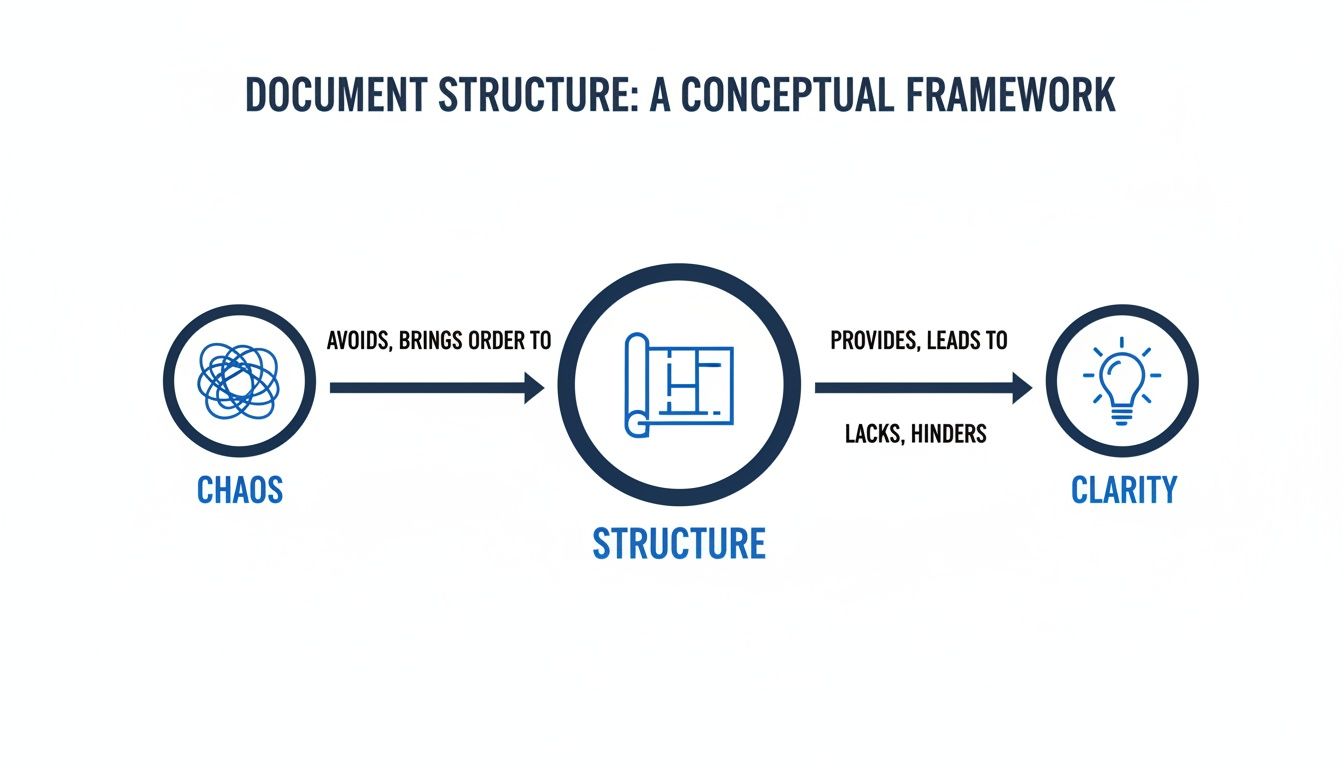
Picture a perfectly organised kitchen. You know exactly where the spatula is, the spices are labelled, and everything has its place. Making a meal is a joy, not a frantic search. That’s precisely what good structure does for your documents—it makes finding and understanding information effortless.
These aren't just fussy formatting rules. They're the fundamental tools you use to build clarity and guide your reader, turning a daunting wall of text into an intuitive, helpful resource.
Headings Are Your GPS
Your headings (H1, H2, H3, etc.) are the most powerful signposts you have. They break down your content into digestible, logical chunks and tell the reader, "Here's what this bit is about."
- H1 (The Title): This is your main event, the name on the front of the book. There's only one, and it needs to nail the document's entire purpose.
- H2 (Main Sections): Think of these as the major chapters. They split your document into its primary themes or big ideas.
- H3 (Sub-sections): These are the finer points within each chapter, drilling down into more specific details.
This clear hierarchy is a game-changer. It lets people scan your document in seconds and find exactly what they need. And when you remember that a whopping 81% of people only skim online content, you realise a document without good headings is like a map with no roads.
Lists And Tables Tame The Chaos
Once you have your headings, lists and tables are your secret weapons for making complex information look simple. They’re your best defence against the dreaded dense paragraph.
A quick bulleted or numbered list is perfect for laying out steps, features, or key takeaways. For instance, you can't write a decent technical guide without them. To see this in action, check out our guide on how to write a great product requirement document, which uses lists to make complex feature sets crystal clear.
Tables are your go-to for any kind of comparison. Instead of trying to explain the pros and cons of two different software options in a long-winded paragraph, a simple two-column table makes the differences pop instantly.
Structure isn't about restriction; it's about freedom. It frees your reader from confusion and frees your ideas to be understood clearly and quickly.
To help you get started, here’s a quick-reference table outlining the core components and when to use them.
Your Document Structure Toolkit At A Glance
| Component | Primary Purpose | Best Used For |
|---|---|---|
| Headings (H1, H2, H3) | Creating a scannable hierarchy | Organising topics and sub-topics, guiding the reader's journey. |
| Bulleted Lists | Highlighting non-sequential items | Listing features, benefits, or key takeaways. |
| Numbered Lists | Outlining sequential steps | Step-by-step instructions, processes, or ranked items. |
| Tables | Comparing data points directly | Showcasing pros and cons, feature comparisons, or pricing plans. |
| Blockquotes | Emphasising a key message | Highlighting powerful quotes, core principles, or critical warnings. |
| Bold Text | Drawing attention to key terms | Calling out statistics, keywords, or must-remember phrases. |
Think of these as the essential tools in your writing toolbox. Mastering them is the first step toward creating documents that people actually want to read.
Proven Document Frameworks You Can Steal Today
Right, so you've got a handle on the basic building blocks of a solid document. Now for the fun part. It's time to stop reinventing the wheel every time you open a new page and start using proven frameworks. Think of them as reliable recipes for organising your thoughts.
Using a good framework is like having a secret weapon. It ensures your document actually does what you need it to do, whether that's persuading your boss, explaining a process, or guiding a teammate. Instead of being paralysed by that blinking cursor on a blank screen, you can just pick a battle-tested document structure that fits the job. Trust me, it saves a mountain of time and makes your work clearer from the get-go.
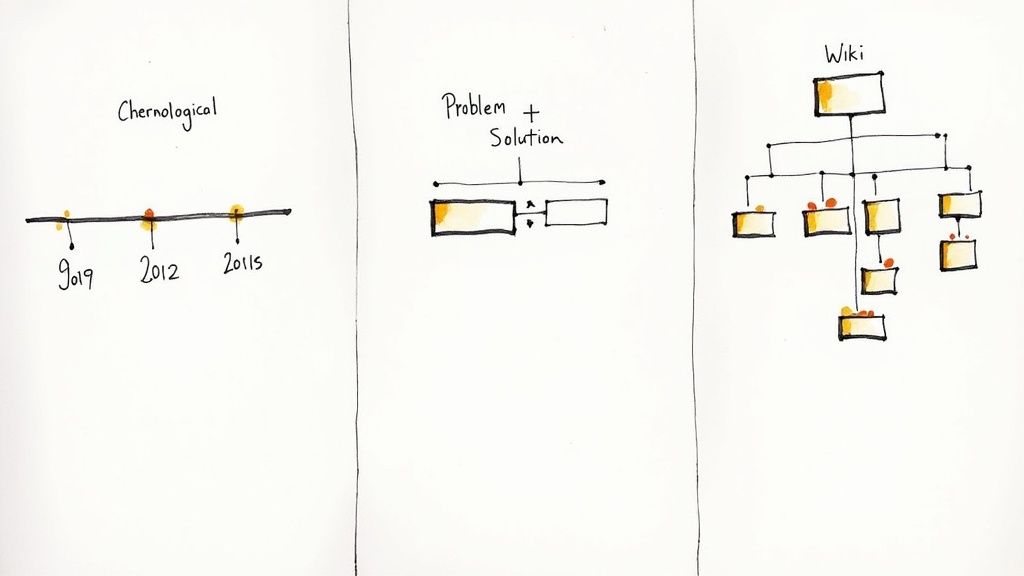
The Chronological Structure For Narrating Progress
When you need to tell a story from start to finish, the chronological structure is your best friend. It simply lays things out in the order they happened. It’s natural, it’s intuitive, and it’s incredibly difficult for readers to get lost.
This approach is a perfect fit for:
- Meeting Notes: Capturing discussions and decisions as they unfold in real-time. If you find your meeting notes often end up a jumbled mess, our guide on using a meeting planner can turn you into a sequential note-taking pro.
- Project Updates: Walking stakeholders through a project's journey, from the initial kickoff to the final milestone.
- Incident Reports: Laying out the clear sequence of events that led to an issue, what happened during the chaos, and the steps taken to fix it.
The real beauty here is its simplicity. By following a natural timeline, you create a narrative that just flows, making even the most complex chains of events easy to follow.
The Problem-Solution Framework For Persuasion
Need to convince someone of something? The problem-solution framework is your go-to persuasive powerhouse. This structure works by first shining a massive spotlight on a painful problem and then positioning your idea as the hero that saves the day.
The pattern is simple but devastatingly effective:
- State the Problem: Go deep. Clearly explain the challenge, what’s causing it, and why it hurts. Use hard data and real examples to make it feel urgent and real.
- Present Your Solution: With the stage set, introduce your idea, product, or plan as the direct answer to the pain you just described.
- Show the Benefits: Don’t just say it’s better—prove it. Detail exactly how your solution makes the problem disappear and what amazing results will follow.
This is the very backbone of killer proposals, compelling case studies, and strategic plans for a reason. It taps directly into our human desire to see problems solved.
By framing your ideas as the solution to a clear problem, you turn a simple suggestion into something that feels like an undeniable necessity.
The Hierarchical Structure For Building Knowledge
If you're building something big and interconnected, like a company wiki, a knowledge base, or a detailed user manual, the hierarchical structure is the undisputed king. It organises information from the broadest categories all the way down to the nitty-gritty details.
Picture it like a perfectly organised digital filing cabinet. The main topics are the big drawers ("Marketing," "Engineering"). Inside those are the folders, or sub-topics ("SEO Strategy," "Codebase Guidelines"). And inside the folders are the individual documents and articles. This nested, top-down approach lets people navigate enormous amounts of information without feeling overwhelmed, quickly finding the one specific thing they need.
A High-Stakes Lesson in Document Structure
If you still think a solid document structure is just for corporate neat freaks, let's talk. We need to move beyond tidy meeting notes and project plans to a scenario where the stakes couldn't be higher: national survival. This is a story about how structure became a tool for transformation, right in the middle of a war.
Imagine the monumental task facing Ukraine: aligning thousands of national laws, administrative papers, and regulations with the famously complex standards of the European Union. Now, picture doing that during an active invasion. It’s the ultimate stress test for any system of organisation.
This wasn't just about shuffling paperwork. This was about forging a coherent, compliant, and transparent system from a state of wartime chaos. Success meant a future integrated with Europe; failure meant falling further into disarray.
From Chaos to Coherent Roadmaps
The first step was to tame the storm. Instead of getting lost in thousands of disconnected legal documents, Ukraine took a structured, top-down approach. They needed to create clear, overarching frameworks to guide the entire, sprawling process.
This strategy took shape when the government adopted comprehensive roadmaps for the rule of law, public administration reform, and the functioning of democratic institutions. These weren't just vague goals scribbled on a whiteboard. They were meticulously structured frameworks designed to align Ukraine's entire legislative and administrative machine with EU standards. We're talking about systematically transposing over 35 chapters of EU law into their national legislation. You can dive deeper into this strategic framework in the official 2023 report on Ukraine.
This high-level structure provided the blueprint needed to coordinate work across countless government agencies, all while under immense pressure. It created a single source of truth and, crucially, a clear path forward.
Why This Structure Was a Game Changer
Adopting these frameworks was so much more than an administrative exercise. It was a profound shift that kicked off systematic change on a national scale. Here’s what it really made possible:
- Ensured Data Integrity: With standardised formats, information could finally be tracked, verified, and compared accurately—something absolutely critical when you’re dealing with legal compliance.
- Drove National Reform: The structure itself forced a methodical review of existing laws and practices. It shone a spotlight on the gaps and drove the necessary reforms in a logical, step-by-step sequence.
- Enabled Collaboration: It gave different ministries and international partners a common language and a shared framework to work within. This stopped people from duplicating effort and tripping over each other in confusion.
In the most challenging conditions imaginable, a clear document structure wasn't a "nice-to-have." It was the essential mechanism that made a monumental geopolitical goal achievable, one organised step at a time.
This powerful example proves that exceptional document structure is never just about tidiness. It’s about creating systems that can withstand immense pressure and make large-scale, systematic change possible. It shows that when you get the structure right, you can build clarity, drive real progress, and achieve incredible things—even when the world around you is in chaos.
When Document Structures Collapse: A Real-World Catastrophe
So far, we've talked about document structure as a neat way to stay organised and efficient. But what happens when that structure doesn't just get messy—it gets completely wiped out? The fallout isn't just a minor headache. It’s a full-blown catastrophe that can bring society to a grinding halt and effectively erase people's pasts.
Think of it like this: imagine your house wasn't just built on a shaky foundation, but the blueprint, the deed, and every single photo you own vanished in a puff of smoke. This isn't just a dramatic thought experiment. For millions of people, it’s a living nightmare when information systems—both physical and digital—suffer a total collapse.
The Anatomy of Systemic Failure
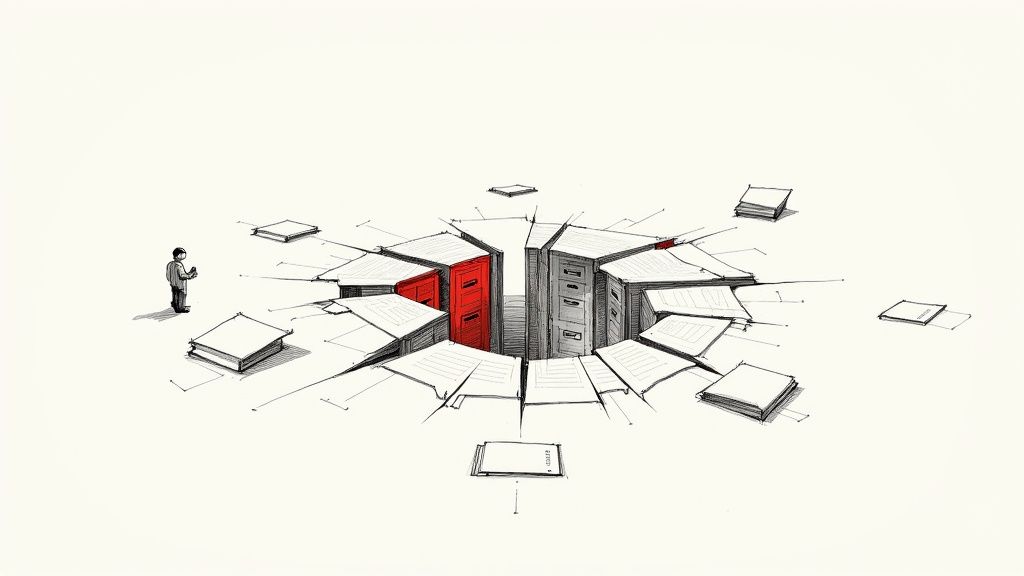
When a document structure implodes on a massive scale, it sets off a devastating chain reaction. The initial loss of data is just the first domino to fall. The real crisis is the total paralysis that follows, as essential services lose the very information they need to function.
This isn't just about a few lost files. It's about the entire system that relies on them. All of a sudden, you can’t prove you own your home. A university can’t verify your degree. A government can’t deliver aid because the records of who needs it and where they are have vanished. The very fabric of trust and verification, which is built on organised information, completely unravels.
A Sobering Real-World Example
Nowhere is this more gut-wrenchingly clear than in the aftermath of widespread destruction. A World Bank assessment in Ukraine paints a harrowing picture of what happens when a country's document infrastructure is decimated. The report found that immense damage to the housing sector—impacting over 2.5 million households—also obliterated the physical and digital records tied to them. Property titles, public registries, and land records simply ceased to exist, creating almost impossible barriers to recovery. You can read the World Bank’s detailed assessment to get the full, sobering picture.
This massive loss of records creates a nightmare scenario for citizens and recovery efforts alike.
- Proof of Ownership Vanishes: Without property titles, families displaced by conflict have no legal way to reclaim their homes or land, leaving them trapped in a devastating limbo.
- Reconstruction Grinds to a Halt: How can you possibly rebuild a neighbourhood when the official land records are gone and no one can verify property lines or ownership?
- Identity and History Erased: The loss goes far beyond property. Destroyed public registries and academic archives mean people lose access to their birth certificates, educational qualifications, and other crucial pieces of their identity.
When a society's records are destroyed, its ability to function and rebuild is crippled. The loss of structure creates a void where accountability, ownership, and even personal history can no longer be verified.
This powerful and tragic example is a stark warning for all of us. A resilient and well-managed document structure isn't some administrative luxury; it's a fundamental pillar of a functioning society. Building robust systems, underpinned by a solid document management workflow, is absolutely essential for withstanding crises. It ensures that when disaster strikes, a society’s memory—and its people’s identities—don't disappear along with the buildings.
Got Questions About Document Structure? We've Got Answers.
Feeling that spark of inspiration but now you’re staring at the mountain of work ahead and thinking, "Where on earth do I even start?" Don't worry, that's completely normal. Going from a whirlwind of chaotic notes to a clean, structured system feels like a huge leap, but it’s really just a series of small, smart steps.
We’ve rounded up the most common questions people ask when they’re ready to get organised. Here are some straightforward, practical answers to get you moving.
Where Do We Begin? What’s the Very First Step?
Start small. Seriously. Before you can build a shiny new system, you need to know what you're dealing with. Kick things off with a simple document audit. Think of it like a spring clean for your team's knowledge. Figure out where everything lives, what's embarrassingly out of date, and what causes the most headaches.
Once you’ve surveyed the scene, pick one thing to fix. Just one. Agree on a dead-simple naming convention and a basic folder structure. Don't try to reorganise the entire company overnight. Instead, tackle a high-impact area, like your project plans or meeting notes, and create a single, crystal-clear template for it. Nailing a small, visible win is the best way to build the momentum you need for the bigger changes down the line.
The goal isn't to perfectly organise everything by Friday. It's to stop the chaos from getting worse and create a small island of order that your team can actually use and appreciate.
Help! How Do We Deal with the Thousands of Old, Messy Documents We Already Have?
Whatever you do, don't try to fix everything at once. That’s a one-way ticket to burnout and giving up. The secret is to triage the mess and tackle it in manageable bites.
Here’s a simple, three-step plan:
- Archive the Obvious. Start with the low-hanging fruit. If a document hasn't been touched in over a year and isn't some critical legal or historical record, get it out of the way. Move it to an archive folder so it’s out of sight and out of mind.
- Focus on the Crown Jewels. Next, identify the top 10-20% of documents that your team uses constantly or that are absolutely vital to your work. Pour all your initial energy into restructuring these high-impact files first.
- Restructure as You Go. For everything else, introduce a simple rule: the next time anyone needs to use or update an old document, they're responsible for converting it to the new structure. This "fix-it-when-you-touch-it" approach cleans up the legacy mess organically over time, without needing a massive, soul-crushing project.
This strategy stops the problem from getting bigger while making sure your most important information gets sorted out first.
What Features Should We Look for in a Tool to Help Us Stay Organised?
When you're picking a tool to help you maintain this newfound order, there are three features that really matter. First, it absolutely must have powerful templating capabilities. The ability to create a pre-built structure for common documents—like project briefs, client reports, or 1-on-1 notes—is the key to making consistency the default, not the exception.
Second, you need flexible ways to organise your work. Look for features like nested pages, tags, and a search function that actually works. These are the building blocks that let you create a clear information hierarchy that can grow with your team without turning into a tangled mess.
Finally, collaboration tools are non-negotiable. A good platform will have a clear version history and let people leave comments and have discussions right there on the document. This is what keeps your carefully crafted document structure from falling apart the minute multiple people start editing. The right tool makes staying organised the easiest option.
Ready to turn your team’s chaotic notes into a clear, actionable knowledge base? With Notie, you can build smart templates, organise information effortlessly, and collaborate without confusion. Start building a better document structure today at https://notie.pro.